
The climate change issue is getting real and has a wide impact on human life. This condition encourages many actions to reduce greenhouse gas emissions globally; one of them is implementing carbon credits.
Through carbon credits, emissions reductions not only affect the environment but also have economic value. Carbon credits are a system allowing many parties to contribute more. Let’s learn how carbon credits work and the benefits here!
What Are Carbon Credits?

Carbon credits are units or certificates representing a reduction of 1 ton of carbon dioxide (CO₂) emissions from the atmosphere. In other words, these credits demonstrate that a given activity reduces or sequesters greenhouse gas emissions.
Carbon credits are units that can be bought and sold on the carbon market. This is a trading system in which emitters and those who can reduce emissions trade carbon credits.
The carbon market allows companies or countries that have successfully reduced their emissions to sell their surplus carbon credits. Conversely, parties that still emit can purchase these credits to meet their emission reduction targets or as a form of compensation (carbon offsetting).
Read also: What Is Decarbonization? Definition, Benefits, and Examples
Purposes of Carbon Credits

Credit carbons aim to reduce global greenhouse gas emissions through measurable, responsible mechanisms. Every emission reduction can be calculated, verified, and given economic value.
Moreover, carbon credits also aim to encourage a shift to a low-carbon economy. Companies and countries need to use renewable energy, increase energy efficiency, and adopt eco-friendly technology.
How Carbon Credits Work
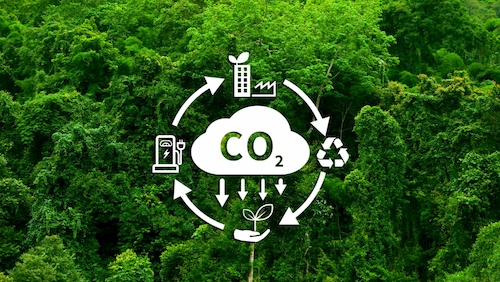
The way carbon credits work is actually quite simple. It connects parties that have successfully reduced emissions with those that still produce emissions through a trading mechanism.
The process begins with activities that reduce or absorb carbon emissions, such as using renewable energy, reforestation, or energy efficiency. From those, the amount of reduced emissions is calculated, with 1 carbon credit equivalent to a reduction of 1 ton of CO₂.
Afterward, the emission reductions must be verified by an independent body to ensure the results are valid, measurable, and compliant with standards. If approved, the carbon credits are issued and ready for trading.
The next step is trading on the carbon market. These credits can be purchased by companies or organizations seeking to offset their emissions (carbon offset). Through this mechanism, carbon credits not only help reduce global emissions but also provide economic value to those contributing to environmental conservation.
Advantages of Carbon Credits
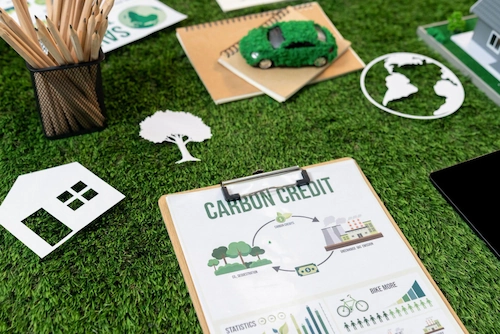
Carbon credits offer various benefits for the environment, economy, and business. Here are some of them:
Reducing Greenhouse Gas Emissions
Carbon credits encourage various stakeholders to actively reduce emissions through eco-friendly projects. Through this mechanism, every effort, such as the use of renewable energy, reforestation, or energy efficiency, can be quantified and monetized.
Protecting Nature on a Large Scale
Carbon credits enable significant investment in environmental conservation projects, such as forest and mangrove restoration. It has a real impact on preserving ecosystems and enhancing nature’s ability to absorb carbon.
Encouraging Sustainable Land Management
Carbon credits encourage the adoption of practices such as agroforestry and regenerative agriculture. In addition to reducing emissions, these practices provide benefits such as maintaining soil fertility, improving water quality, and preserving biodiversity.
Read also: Carbon Capture and Storage: Technology to Reduce CO2 Emissions
Examples of Carbon Credit Projects
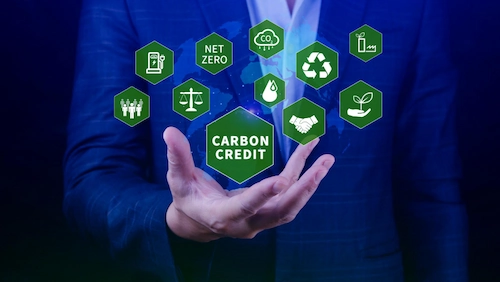
Carbon credit projects mostly come from activities that can measurably lower or absorb greenhouse gas emissions. Below are some of the examples:
- Renewable energy: The development of solar, wind, or hydroelectric power plants to replace fossil fuels and significantly reduce carbon emissions.
- Energy efficiency: The implementation of energy-saving technologies in industry, buildings, or transportation that can reduce energy consumption and resulting emissions.
- Carbon capture (CCS): Carbon capture and storage (CCS) technology that captures CO₂ emissions from industrial sources and stores them underground to prevent their release into the atmosphere. For example, post-combustion emission capture projects at coal-fired power plants.
- Waste management: Biogas installations to utilize methane gas from agricultural and livestock waste; landfill gas capture at landfills; and organic composting systems, both on an industrial and household scale.
- Nature-based solutions: Reforestation or mangrove restoration to absorb CO₂; peatland restoration; forest conservation and sustainable agriculture.
- Social projects: Community-based programs, such as distributing fuel-efficient stoves or water filters for remote areas.
That is the information about carbon credits, including definition, mechanism, advantages, and examples. Through this mechanism, efforts to reduce emissions not only benefit the environment but also create opportunities for sustainable economic growth.
Aside from understanding carbon credits, you can also contribute to preserving the environment by joining Indonesia Asri. You can join Jejak Asri and share various real actions in implementing an eco-friendly lifestyle.
You can also win millions of rupiah if your story gets chosen. So, don’t hesitate to participate and share your story before 16 October 2026!
Read also: Carbon Footprint: Definition, Causes, and How to Reduce It