Key Takeaways
- In 2026, 75% of waste in Indonesia remained improperly managed, up from 59% in 2025.
- Households were the largest source of waste in Indonesia in 2025.
- Food waste makes up the largest share of Indonesia’s waste composition, at around 40%.
Waste generation is an environmental challenge in Indonesia that must be continuously monitored to prevent pollution and protect public health. Addressing this issue requires collaboration among various stakeholders, including communities, policymakers, and waste management operators.
Where does Indonesia’s waste come from, and which types of waste account for the largest share? Read on to explore the latest waste data from Indonesia.
Waste Data in Indonesia: Waste Management Statistics
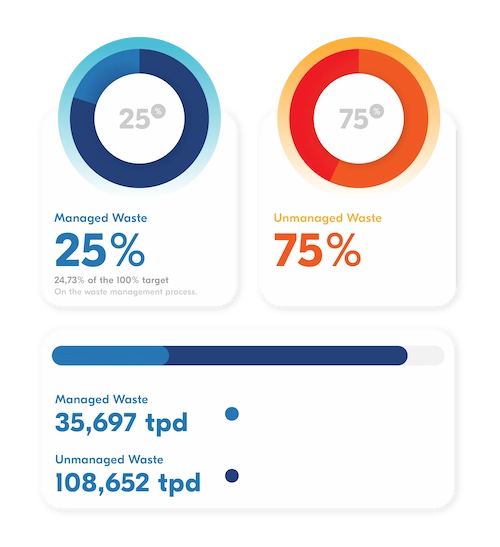
Waste statistics in Indonesia reported by the Ministry of Environment’s National Waste Management Information System (Sistem Informasi Pengelolaan Sampah Nasional/SIPSN) show that in 2026, 75% of waste, roughly 100,000 tons per day, from 514 regencies and cities remained unmanaged. Meanwhile, only 25%, or around 35,000 tons per day, was properly managed.
What about Indonesia’s waste data in 2025? SIPSN recorded approximately 91,000 tons of waste generated per day across 304 regencies and cities. Waste generation refers to the amount of waste produced by community activities across various sectors within a given area.
From the total amount, 31% of the waste, or approximately 28,000 tons per day, was managed, while the remaining 59% was not properly managed. Another surprising fact is that much of the waste was disposed of through open dumping, a waste disposal method in which waste is left in open areas without being properly lined or covered. Open dumping does not meet the requirements for proper final waste disposal because it involves piling waste in a depression or designated area without further treatment.
If left unchecked, waste in open areas can worsen air quality, contaminate the environment, and threaten the health of nearby communities. Open dumping also remained a common waste disposal method in cities across Indonesia as of 2026.
Read also: 6 Waste Management Strategies You Can Wisely Implement
Where Does Waste Generation Come From?
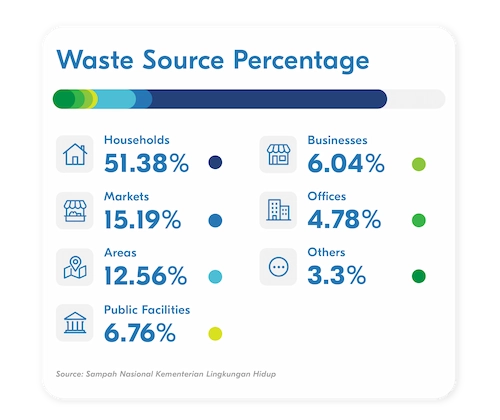
SIPSN records that waste generation in Indonesia comes from households, offices, commercial areas, markets, public facilities, residential or industrial areas, and other sources. Here is Indonesia’s waste data by source for 2025:
- Households: 52,153.44 tons per year (51.38%).
This sector contributes the most to national waste generation. Household waste generally consists of food scraps, kitchen waste, and packaging.
- Markets: 15,418.75 tons per year (15.19%).
This sector is generally dominated by organic waste, such as leftover vegetables and fruit, animal protein waste, and various types of inorganic waste.
- Areas: 12,751.5 tons per year (12.56%).
Special-use areas typically generate waste from manufacturing and logistics activities.
- Public facilities: 6,867.75 tons per year (6.77%).
This waste comes from public squares, roads, and other public areas. Waste types vary, ranging from organic waste, such as dry leaves, to inorganic waste generated by community activities.
- Commercial areas: 6,123.79 tons per year (6.03%).
This sector generally generates inorganic waste, such as cans, packaging, string, and other materials.
- Offices: 4,847.84 tons per year (4.78%).
Office waste typically includes used paper, old newspapers, discarded office supplies, and cardboard.
- Other sources: 3,347.01 tons per year (3.3%).
Waste Generation Data by City/Regency
In addition to presenting overall waste generation data, SIPSN also provides waste generation data for individual cities and regencies through a distribution map. Below is a summary of waste generation data from several cities and regencies across Indonesia in 2026:
- Pekanbaru: 1,050.84 tons per day.
- Batam: 1,161 tons per day.
- South Lampung Regency: 787.28 tons per day.
- Tangerang: 1,370.14 tons per day.
- Cilegon: 336.36 tons per day.
- Bogor: 755.36 tons per day.
- Bandung: 1,573.7 tons per day.
- West Jakarta Administrative City: 1,943.13 tons per day.
- North Jakarta Administrative City: 1,410.64 tons per day.
- Semarang: 544.36 tons per day.
- Sleman Regency: 585.3 tons per day.
- Pati Regency: 690.96 tons per day.
- Surabaya: 1,810.81 tons per day.
- Malang: 731.24 tons per day.
- Jember Regency: 1,046.35 tons per day.
- Denpasar: 1,033.08 tons per day.
- East Lombok Regency: 583.04 tons per day.
- Sumbawa Regency: 290.05 tons per day.
- Manggarai Regency: 136.06 tons per day.
- Central Maluku Regency: 216.18 tons per day.
- Makassar: 1,034.48 tons per day.
- Ketapang Regency: 296.26 tons per day.
- Samarinda: 607.95 tons per day.
- Mimika Regency: 197.16 tons per day.
Discover more: 10 Examples of Hazardous Waste and Their Characteristics
Waste Composition in Indonesia Based on Types
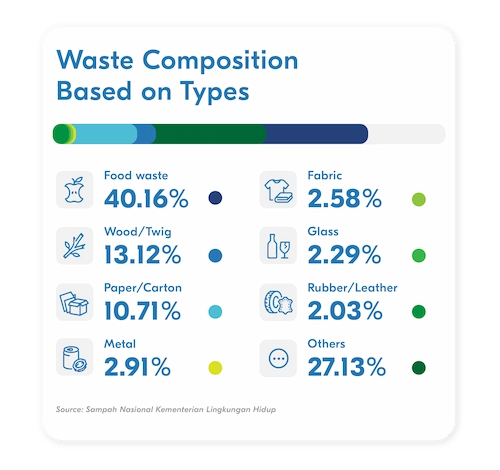
You may be wondering what types of waste are generated in Indonesia. According to SIPSN data, waste composition consists of food waste, wood/branches, paper/cardboard, metal, textiles, rubber/leather, glass, and other types of waste.
In 2025, food waste accounted for the largest share of total waste generation at approximately 40.16%, followed by other waste at 27.13%, wood/branches at 13.12%, paper/cardboard at 10.71%, metal at 2.91%, textiles at 2.58%, glass at 2.29%, and rubber/leather at 2.03%.
How Can Waste Be Repurposed?
Not all waste needs to end up at a landfill. Some types of waste can still be processed into new, useful products. For example, you can turn organic food scraps into compost, cardboard into handicrafts, fabric scraps into tote bags, cans into jewelry, and glass into decorative items.
Before processing waste, sort and group it according to type. Then, wash the waste thoroughly and let it dry. After that, you can get creative and transform waste materials into handicrafts.
You can also take your waste to a waste bank or recycling community for further processing. This way, waste that would otherwise end up in a landfill can be reused and turned into something with economic value.
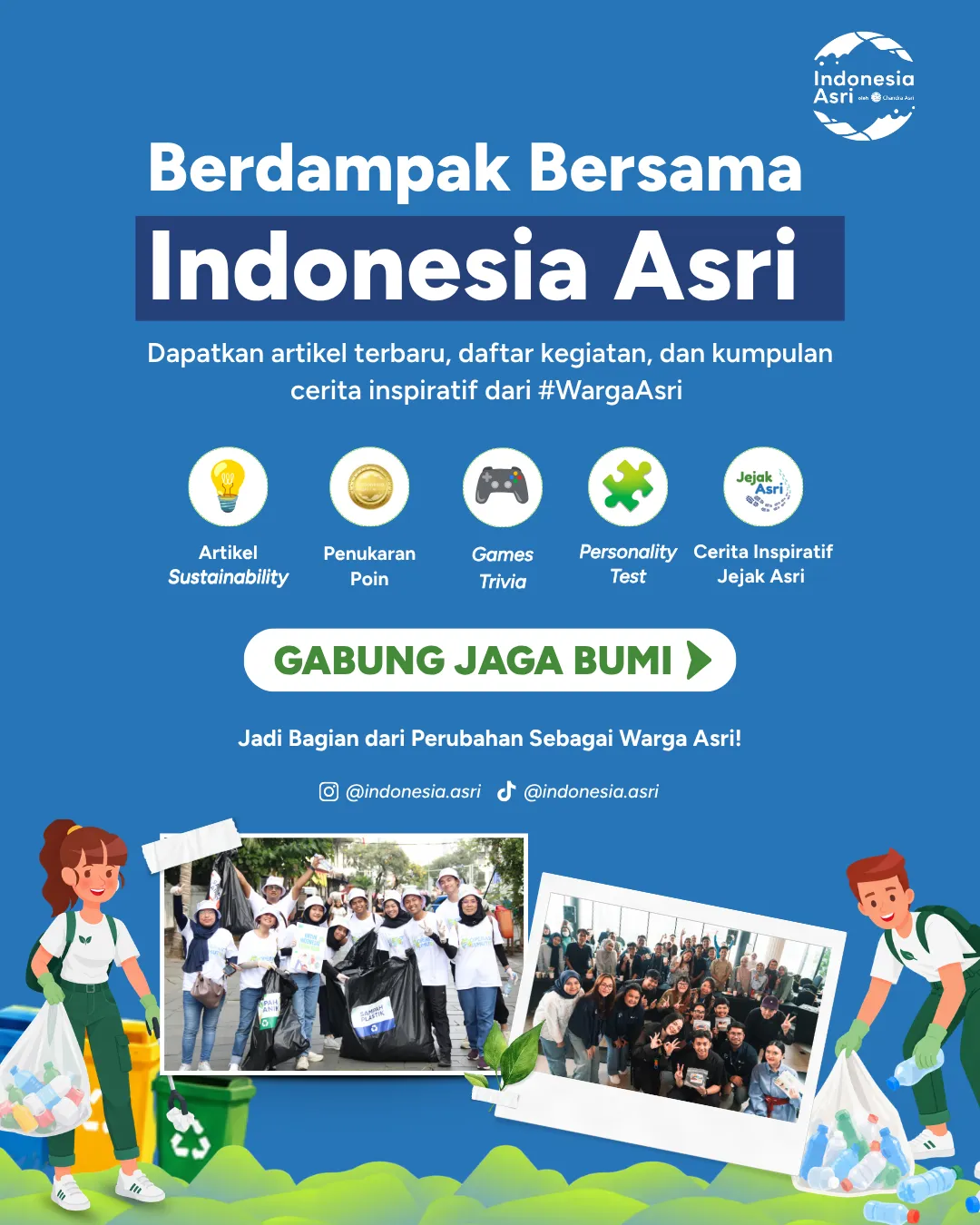
Keep the Environment Clean and Waste-Free with Indonesia Asri!
Waste is a byproduct of people’s everyday activities, whether at home, businesses, schools, or other facilities. It keeps growing every day, making proper waste management essential to prevent environmental pollution and reduce risks that could harm public health.
With Indonesia Asri, you can start managing waste by sorting it. You can join one of the #AksiAsri programs, Operasi Semut. This initiative educates communities about the importance of sorting waste before disposal (#pilahsampah) to help create a more sustainable environment.
Let’s keep our surroundings green and minimize pollution! Sort your waste before throwing it away to make it easier to process, and always dispose of waste in the proper place. Also, don’t miss the next Operasi Semut! Become Warga Asri to stay updated on all the exciting activities from Indonesia Asri!
You May Also Know: Indonesia Waste Management Issues: Challenges and Solutions
Frequently Asked Questions (FAQ)
Still have questions about waste data in Indonesia? Find the answers in the frequently asked questions below:
1. What Percentage of Waste Is Properly Managed in Indonesia?
According to SIPSN, 25% of waste was properly managed, while the remaining 75% was not properly managed in 2026.
2. What Is the Most Common Type of Waste in Indonesia?
According to 2025 data, food waste was the largest type of waste in Indonesia, accounting for approximately 40% of the overall waste composition. Meanwhile, household waste was the largest source of waste in Indonesia, accounting for approximately 51%.
3. How Much Waste Does Each Person Generate per Day in Indonesia??
According to SNI 3242:2008, waste generation in smaller cities is approximately 2.5 liters per person per day, while in larger cities it is approximately 3 liters per person per day.