
Climate change is now getting tangible and impacting our daily lives, from extreme weather to global temperature increases. One of the efforts we can make to tackle it is through economic regulations aiming to reduce carbon emissions.
A carbon tax is a measure used to place a monetary value on the pollution generated. With this policy, businesses and the public are expected to become more conscious of reducing their carbon footprint and switching to more environmentally friendly energy sources.
Then, what is a carbon tax, and how is the implementation in Indonesia? Read this article until the end!
What Is a Carbon Tax?
A carbon tax is a fee imposed on entities that generate carbon emissions, calculated in units of tons of carbon dioxide equivalent (CO₂e). These emissions typically result from the combustion of fossil fuels such as coal, oil, and natural gas, generated by various industrial and transportation activities.
The primary goal of a carbon tax is to reduce the amount of greenhouse gas emissions. With this tax, businesses will be encouraged to use more environmentally friendly energy or reduce activities that generate pollution.
In addition to helping protect the environment, a carbon tax can also serve as a source of government revenue. Funds generated from this tax can be allocated to environmental programs, such as the development of green energy or ecosystem restoration.
The Carbon Tax Implementation in Indonesia
Carbon taxes in Indonesia are being implemented gradually according to a roadmap established in 2021. During the year, the government launched the legal framework through Law No. 7 of 2021 on Tax Regulation Harmonization (HPP Law) as the foundation for implementing this policy.
It was further reinforced by implementing regulations such as Government Regulation No. 40 of 2025, which outlines the mechanisms and sectors subject to the carbon tax.
Subsequently, in 2022, the initial implementation began to focus on the energy sector, specifically coal-fired power plants (PLTU), using a cap-and-tax scheme.
The cap-and-tax scheme is an Indonesian government policy implemented by setting a cap (maximum quantity) on the amount of carbon that may be emitted. A new tax rate is imposed if a power plant or business entity emits more than the predetermined cap.
Furthermore, in 2025, the implementation of the carbon tax was planned to be broader and integrated with the carbon market mechanism. At this stage, the scope of sectors will be gradually expanded to include industry, transportation, and other sectors.
Read also: Carbon Credits: Definition, Advantages, and Mechanisms
Carbon Tax Subjects
The carbon tax subjects are individuals or business entities responsible for the carbon emission tax. In general, the subjects are from sectors emitting greenhouse gas emissions in significant amounts, such as:
- Companies or industries using fossil fuels.
- Manufacturing sectors that have high-emission production processes.
- Energy, transportation, and mining business entities.
- Other business entities that emit carbon above the fixed limit.
Carbon Tax Objects
According to Law Number 7 of 2021 on Tax Regulation Harmonization (HPP Law), the determined carbon tax tariff is Rp20 per kg CO₂e at a minimum, or Rp30,000 per ton CO₂e.
The carbon tax rate was set with a view to balancing emission reduction efforts and national economic conditions. Therefore, the carbon tax rate may be adjusted gradually in line with price movements in the carbon market.
Read also: What Is Decarbonization? Definition, Benefits, and Examples
Advantages of Carbon Tax
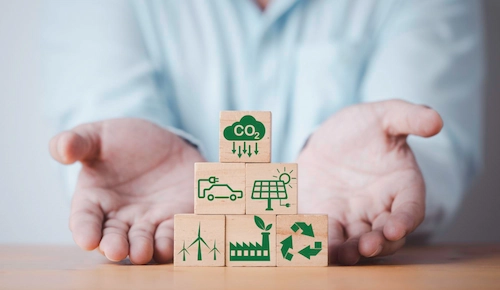
A carbon tax provides significant advantages for the environment and economy. This regulation is crafted to control emissions and encourages behavior changes towards more environmentally friendly activities. Here are some of the advantages:
- Reducing greenhouse gas emissions: A carbon tax fosters business entities and people to reduce emissions due to the cost of the released pollution.
- Supporting the transition to cleaner energy: It makes renewable energy more appealing since fossil energy appears more costly.
- Increasing the nation’s income: A carbon tax can be income for a nation, which later can be used to develop sustainable and environmentally friendly infrastructures.
- Increasing environmental awareness: A carbon tax increases environmental awareness and the importance of reducing one’s carbon footprint.
- Establishing eco-friendly technology innovations: It triggers the development of low-carbon technologies and environmentally friendly solutions to reduce emissions more effectively.
That is an overview of a carbon tax from its definition, benefits, and implementation. Through this regulation, efforts to reduce emissions not only benefit the environment but also help encourage a more sustainable economic system.
Along with understanding carbon tax policies, you can also play a tangible role in protecting the environment through simple steps in your daily life, from reducing energy consumption and managing waste wisely to choosing more eco-friendly products.
You can also amplify this impact by joining the environmental movement with Indonesia Asri. Through the Jejak Asri campaign, you can share your stories and various concrete actions you have taken to adopt an eco-friendly lifestyle.
The best part is you also have the chance to win prizes worth up to millions of rupiah if your story is selected. Come on, share your experience before October 16, 2026!
Read also: Carbon Footprint: Definition, Causes, and How to Reduce It